Monday, May 14, 2018

Tomato Sauce 101


There are 3 things I do not mind buying in a can:

  1. Chipotle peppers in adobe (smoked jalapeno peppers in a lovely tomato sauce) -- they are a great addition to marinades, baked beans, chili, taco meat ... you name it!
  2. Beans -- I never cook beans from scratch.  The canned versions save me so much time and they taste perfect.  Just give them a good, healthy rinse with cold water and proceed.
  3. TOMATOES! -- most especially the Italian variety (they just taste better!).  Even in California, with our year round growing season, the time of year when tomatoes are at their peak is limited.  And the ones you buy at your random supermarket most likely were picked before they were ripe in some far-off land, so they are mostly water and zero flavor.  The canned ones are optimal, especially for soups and sauces!

Beth's Super Easy, Homemade Tomato Sauce

Chef's note:  You can easily double or triple this recipe.  It takes just as much time and energy to cook 2 quarts as it does a gallon.  Just put it in pint-size containers and store it in the freezer for when you need it.  Making tomato sauce from scratch is much easier than one would think.  It not only tastes better, but it is much better for you than the processed stuff in a jar.

2-28oz cans canned tomatoes (preferably Italian, whole; crushed by hand)
1/3 cup extra virgin olive oil
8-10 garlic cloves, smashed with skins removed
1/2 teaspoon dried chili flakes (plus more to taste, at the end)
A big handful of basil
1" square of Parmesan cheese rind, or just a chunk of Parmesan cheese
1 teaspoon of sugar, or to taste
Salt & pepper, to taste


Heat oil over medium heat in a pot that will fit the tomatoes.  Add the garlic cloves and fry them until they are golden brown.  The best way to achieve this is to tip the pan so the cloves are essentially deep-frying.  Once they are starting to brown, use a spoon to pull them out and discard them (or you can leave a few -- it's a matter of taste!).  What you are doing is making sure that the garlicky flavor gets infused with the oil.  

Sprinkle in the chili flakes and cook for about 30 seconds.  Don't let them burn or the sauce will be bitter!  


Very carefully, slide the tomatoes into the oil.  It will spatter, so use caution.  Stir well, and bring to a simmer.  Add the basil and Parmesan bits, and stir to incorporate.  Reduce heat to low, and stir frequently.  Do not allow the bottom to burn!  Continue cooking until the sauce is nice and thick, about 30 minutes or so.  It should coat the back of a spoon.  

Once it is nice and thick, you can either leave it chunky or you can use an immersion blender to puree it a little bit.  (Or carefully pulse in a food processor).  Just be sure to remove the chunk of parmesan.

Season to taste with a little sugar, salt & pepper, and even additional chili flakes if desired.  

Makes 2 quarts.

Saturday, March 31, 2018

My Birthday Tribute to My Mom


My mother was amazing.  She was very artistic and could do wonders with her needlework.  She was patient, kind and never panicked, which made her an amazing nurse (not only professionally, but also to her daughters).  I don’t ever remember her yelling at me – I loved her too much to do anything that would get me into any real trouble.  She was my best friend and, at any age, I felt like I could tell her anything.  She had beautiful blue eyes that she rolled at the world often.  But for her girls, she was always there with a shoulder to lean on or, worst case, to cry on; there was never a shortage of hugs, or encouragement.  The pride that she had in both my sister and me alike often gives me the motivation to keep going and to strive to be the best that I can be. 


However, we all have our Achilles heel, and she was a terrible cook.  For example, a typical meal might involve something Stouffer’s refers to as S.O.S.  It’s shaved “meat” of some kind in a creamy sauce.  Stouffer’s packages it conveniently in plastic so you bring a pot of water to a boil and cook the S.O.S. in it until it is warmed through.  Meanwhile, make toast.  Place the toast on a plate, with the S.O.S. on top.  For those of you not in the know, “S.O.S.” stands for “shit on shingles”.  Pretty accurate.

Another one of our staple meals was Tuna Noodle Casserole.  While the exact details of this recipe are lost, I know it included condensed-cream-of-something-soup, canned tuna, egg noodles and (ew) potato chips to give it that nice crust on the top.  My mother would cook this in an orange oven-safe, round dish that was reminiscent of Le Creuset (but way not).  This was not one of my favorite meals.  When I asked what was for dinner, and she said “Tuna noodle casserole”, I actually cringed. 

Also, macaroni and cheese was another favorite.  Not just straight up from the box (although it was), but she would add things to it.  Sometimes it was sausage, which was OK.  Other days it was Spam, which, even as a child, I was not OK with.  My dad would alternate his condiments on such meals between ketchup and syrup.  As an adult, I alternate my Mac N Cheese topping between the two.  I know how gross that sounds, but it’s pure nostalgia to me!  (Minus the Spam, of course).

Lunch items were often grilled cheese sandwiches (with Miracle Whip), Lipton chicken noodle (from the packet), Stouffer’s French bread pizza, and pizza rolls.  As an adult, after a long day in the kitchen, these are tried and true guilty pleasures (although I take a giant pass on the Miracle Whip).  Not every day staples in my diet, but I admittedly indulge in them from time to time. 

Other entrees included (but were not limited to) meatloaf, which made me throw up once.  Slumgullion, which was not always that terrible.  It’s kind of a chili-mac thing – browned ground beef, kidney beans, tomato sauce and some kind of pasta like macaroni or shells.  I am still a sucker for crunchy tacos which, out of the other possible dinner options was always a welcomed treat!  I would take tacos any day over uber dry pork chops or Salisbury steak.

Side dishes were often frozen veggies heated in the micro with butter.  Salad always included iceburg lettuce with a ketchup-based dressing that was a recipe of my Aunt Elsie’s.  On holidays, the go-to side dishes were green bean casserole (the old-school one with the cream-of-whatever soup and the canned, fried onions) and sweet potato casserole (again, old-school with the marshmallows).  Her potato salad was always a hit, with celery, onion, bacon, hard cooked eggs, mayo … my grandmother’s recipe, which I have actually adapted and improved a little bit.

But let us not forget dessert.  If it was your birthday, she would more often than not cook a cake from a box.  Nothing wrong with that!  As kids, we never complained.  The problem was that sometimes the cakes were raw in the middle!  She would just cover up the sagging middle with more frosting.  My poor mom. 

And then there was her famous jello mold with the pineapple chunks.  She had a special Tupperware mold she used, that had interchangeable bottoms that you could swap out according to what holiday it was.  If it was Christmas, there was a Christmas tree one, etc.  It went on the bottom of the bowl, so when you unmolded it, the selected design was on the top of the mold.  She was a nurse, and her first Thanksgiving with my dad, she made her jello mold.  She took it to work with her and left it in the hospital refrigerator.  After her shift, she went and had dinner at my dad’s with my brothers (I was not born yet).  The following day, one of the doctors she worked with approached her, giggling like a school boy.  “SANDY!  So who got the suppository????”  The answer was “no one”.  My mother was mortified.  As soon as she got off of work, she went to my dad’s house to inspect the remaining jello mold and she saw the suppository right on the edge, next to where the very last scoop had been taken.

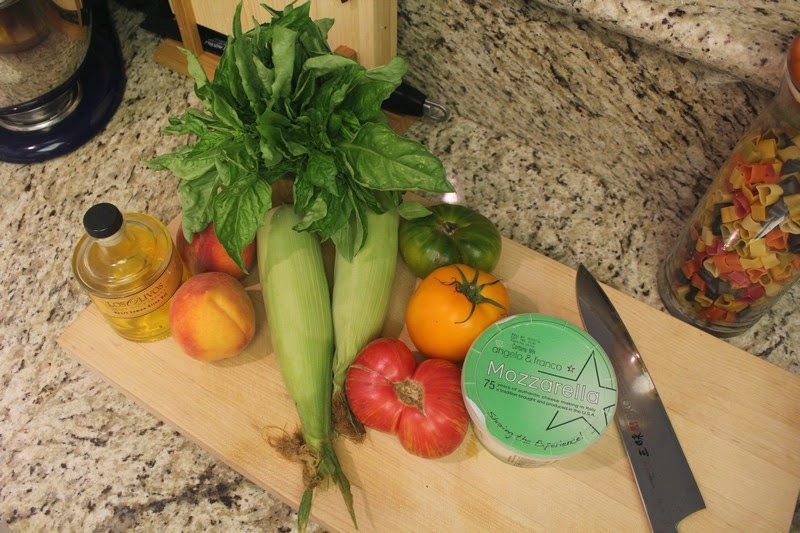
Her food was not always terrible.  In the summer, she liked to barbeque.  We had a charcoal grill and she made pretty good hamburgers and grilled a killer New York steak.  In the summer, we would go to farm stands where she would buy corn on the cob, tomatoes and green beans.  Those meals were my favorites. 

In short, people are always asking me what got me into cooking.  One would assume I was in the kitchen with my mom, propped up on a stool and helping her bake chocolate chip cookies.  That pretty much never happened.  We made sugar cookies together one year for Christmas and I got so frustrated at the end that I ended up mixing all the food coloring together to get black frosting.  No, I knew from a young age my mother could not cook.  I also knew I liked food and my palate was pretty well developed at a young age from, well, being force-fed things. I knew I wanted to cook better, so I learned.  I started reading cookbooks.  I traveled.  I went to culinary school, and upon graduation was the recipient of The President’s Award.  My motivation throughout school was to make my mom proud.  Like I said, she always taught us to work hard and to try our best.  Although she was a terrible cook (and a victim of 70’s and 80’s cuisine), she inspired me to become a better one.    


Tuesday, February 13, 2018

Beth's Chicken Noodle Soup

This is another recipe of mine that is really not a recipe at all.  I play around with it every time I make it, and I would encourage you to do the same.  Let's face it:  there is nothing more comforting on a cold day than homemade soup.  This is a little labor intensive, but make a big batch and keep some in the freezer for days you really don't feel like cooking or for when the kids get sick.  It is well worth the effort and it smells really good!  And for best results, cook the noodles separately so they don't absorb all that wonderful broth. 

Ingredients for stock:

1 large chicken, excess fat removed (and don't forget to take out the neck and nasty bits!)
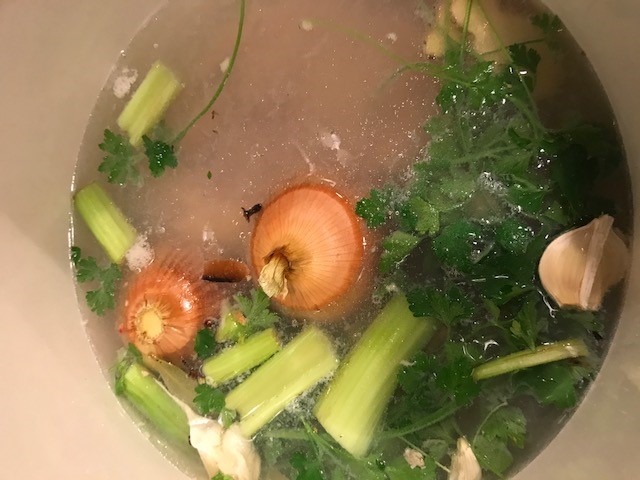
1 large onion, cut in half crosswise (don't bother peeling)
2 large carrots, peeled and cut into 2" chunks
2 celery stalks, cut into 2" chunks
4 garlic cloves, smashed (don't worry about the skin)
4 whole cloves
A 3" section of ginger, cut into 1/4" slices (don't bother peeling)
5 sprigs of parsley
(Optional:  I sometimes get a jalapeno, cut it in half lengthwise and toss that in, too).


1.  Rinse the chicken with cold water and put it into a pot large enough to hold it comfortably and fill the pot with enough water to cover the chicken.  Very slowly, bring the water to a simmer (uncovered) and skim the foam that rises to the surface. 

2.  Meanwhile, in a cast iron skillet or grill pan (or grill for that matter), you want to burn the cut side of the onion.  This sounds odd, but it adds a ton of flavor in the end. 

3.  Throw the onion and the remaining ingredients into the pot with the chicken, continuing to skim the foam.  Maintain a gentle simmer and do not stir.  The foam is the impurities rising to the surface (blood and fat), which you want to get rid of in order to end up with a nice, clean, clear chicken stock. 

4.  After about 30 minutes, the chicken should be pretty much cooked.  Remove from heat and allow to cool.  Once cool, pick the meat off the bones and set aside.  Depending on my mood, I sometimes dice the chicken into little chunks or I shred it.  Makes no difference.  Set aside and refrigerate.

5.  Return bones to pot and bring back to a slow simmer.  Cook for about 2 hours, uncovered, checking for foam and skimming as needed periodically.

6.  Strain through a fine-mesh strainer or through a colander lined with a few layers of cheesecloth, discarding the solids.  Allow to cool in the refrigerator.  Any remaining fat will solidify on the surface and you can just pick it off.


Ingredients for finished soup:

Finished chicken stock (you'll have about 2 quarts at least)
2 large carrots, peeled and small diced (1/4" cubes)
2 celery stalks, small diced
1 small onion, small diced
1 Tbs minced fresh thyme or 1 tsp dried
Reserved chicken meat (diced or shredded)
Juice from 1-2 lemons, to taste
Salt & pepper, to taste
Cooked egg noodles (desired amount, cooked according to package instructions)
2 Tbs minced parsley

1.  Place chicken stock in a large pot with the rest of the veggies and the thyme.  Bring to a boil until the veggies are tender.  Add reserved chicken meat.

2.  Turn off heat.  Add juice of 1 lemon and season with salt and pepper.  Depending on the tartness of the lemon, you may want to add more.

3.  To serve, place desired amount of cooked egg noodles in a bowl and ladle soup over the noodles.  Garnish with parsley.

NOTES:  If freezing, stop at step 2 and portion into containers.  Reheat and continue to step 3 before serving. 

Also, a few splashes of Tabasco or Sriracha are great if you like a little spice in your life!

If you have any mushroom trimmings hanging around, you can throw those in too.  Leeks are a nice addition as well.  Rosemary would probably be good in the stock part of the process ... Or tomato, or tomato paste.  Instead of lemon, you could use lime and swap out the parsley for cilantro.  Chipotle would be great in there, too!  Again.  This is not really a recipe; it's a guide line.  Feel free to tinker with it!

Monday, February 12, 2018

A Day in the Life of a Private Chef


 When I first met the couple that I cook for in La Jolla, I will admit I was a little intimidated.  They have a gated, gravel driveway that is lined with perfectly manicured trees.  At the end of the driveway is a brick courtyard with a fountain and more perfectly manicured trees.  Their house is beautiful and it is accessorized with a tennis court and swimming pool.  The first day I went there, I had no idea what to expect.  The lady of the house (Eileen) and their standard poodle, Wrigley,  greeted me at the door.  The door, mind you, is about 10 feet tall and glass with beautiful ironwork.  She was wearing a gorgeous navy blue ensemble that was perfectly tailored and 100% wrinkle free.  Her hair and makeup were flawless.  We sat down in the kitchen and swapped stories about food, cooking and travelling; we immediately connected, and I was hired.  I will never forget that day. 

That, unbelievably, was 5 years ago.  In that span of time, I came and went twice.  The first time I was overwhelmed with other clients.  My replacement ended up being a disaster, so I agreed to come back.  The second time I left was for reasons in my personal life.  Anyway, I have stayed in contact with them and for the past few months I have been back under their employ. 

Cooking for people on a level that is that personal is extremely rewarding.  It is challenging at times (trying to sort out recipes that don't work, or figuring out substitutions for certain ingredients, etc.), but a very close relationship develops between myself and those I cook for.  With my La Jolla family, I arrive around 3 in the afternoon.  The housekeeper, Denise, does all the food shopping and by the time I get there, she has my station all set up for me and has pulled all the ingredients I will need in order to prepare dinner.  I measure, I dice, I make salad dressings and sometimes a soup for them to stash in the freezer.  Eileen gets home usually by 4:30 and we talk about that night's meal and menus for later in the week, or even the following week.  Usually, I finish cooking by around 5:30.  I plate the courses and Denise serves it to them in their formal dining room.  What makes my heart melt is when I can hear them ooh and ah over how pretty something looks on the plate -- Leonard, the husband, especially.  He gets excited like a little boy over dinner sometimes! 


Most days, they start with a soup or a salad and then there is a main course.  After the main course is served, I do what I can to help Denise break down my station and I make my way into the dining room to see how everything is.  Wrigley, the poodle, comes to me for pets and more often than not jumps up with his giant paws on my shoulders and gives me kisses.  While I get my daily dose of dog loving, I talk with Eileen and Leonard about their dinner and make sure everything tastes OK.  Seeing them truly enjoying something I made for them makes me so happy.  My smile grows even bigger if it is a recipe that is mine that they agreed to let me make for them, or if it was a recipe that totally didn't work, that I was able to salvage.  But, hands down, it is the most gratifying job I have ever had in my life. 

And not only do I have a bond with Eileen and Leonard, but also with Denise.  She is amazing at her job and could not possibly be any sweeter.  We help each other.  I know when she is busy or is having a bad day, so I will clean up the dishes I use.  If a recipe isn't working, I ask her advice on how I should fix it.  I have my own ideas usually, but her second opinion is  always invaluable to me. 

Over the years, I have accrued many fond memories with this family.  One year, Eileen and I cooked Thanksgiving dinner together -- I will never forget it.  We even set a turkey on fire!  This is one of the previously mentioned recipes we had to fix, but everything turned out fine in the end.  My favorite spoon in their kitchen is one that is bent all out of shape.  It's the one Eileen dropped down the garbage disposal one day!  And then there was the time Leonard was trying to show Eileen how to make the dog food and she failed.  I was making risotto and, defeated, she leaned against the stove next to me and said under her breath, "I f&%$ed up the dog food." 

How does one measure success?  Without a doubt, it starts here.  Every day, I leave their home totally in love with what I do.  To enjoy something, to be good at it (or at least I think I'm good at it), and to be able to share that with others is without a doubt one of the most gratifying things on earth. 

Thursday, January 25, 2018

Beth's Secret Recipe BBQ Sauce


Truth be told, this has been a work in progress.  It's not a recipe, per se.  It is based very loosely on a recipe I found a long time ago that I didn't like, so I've been fixing it and experimenting with it.  You are welcome to do the same, depending on your taste.  But I will guide you through it.  It's pretty easy.


Ingredients:

Olive oil, as needed
1/4 cup minced onion (red, yellow, white ... whatever you have; shallots work, too)
2 cloves garlic, minced
1 cup ketchup
1/4 cup cider vinegar
1/2 cup brown sugar (or more, to taste)
1/4 cup Worcestershire sauce (or more, to taste)
2 tablespoons Dijon mustard
2 teaspoons soy sauce

(This is where it gets tricky ....)
1 teaspoon or more Chipotle chili powder (depending on how spicy you like it)
-or- 1 teaspoon smoked paprika (or to taste)
-or- 1 teaspoon regular chili powder (or to taste)
Tabasco, to taste
Salt & pepper, to taste

Wine:  Red, white, whatever

NOTE:  Chipotle powder will be smoky/hot and may require a little extra sugar to calm it down.  Start with a little and you can add as you see fit; if it is too spicy, add more sugar, a little at a time, until it is compatible with your taste buds.  If you want less spice but a nice little hint of smoke, go with the smoked paprika (that's not spicy at all, so you can be a little heavier-handed with it).  If you don't have that, regular chili powder is good too.  Experiment with it!  Again, if it's too spicy, add more brown sugar.  If it is not spicy enough, add more Tabasco or a tiny pinch of cayenne pepper.  

A glass or 2 of wine (I always cook with wine, but it doesn't always end up in the food.  In this case, it's for drinking!)

In a small saucepan, heat enough oil to cover the bottom of the pan over medium-ish heat.  Sweat the onions and garlic (meaning to cook without browning, with a smidge of salt), stirring quite often.  When they are translucent, add the rest of the ingredients, along with whatever spice you choose to use.  Hit it with a splash or two of Tabasco.  

Let it simmer on low for about 15 minutes.  Taste it.  Add salt & pepper to taste.  Too spicy still?  Add more sugar.  Add a little extra Worcestershire sauce.  Add more spices, or mix them up.  It all depends on your palate.  

Most importantly, drink your wine.  ;-)

This yields about a pint of BBQ sauce.  It will hold in the fridge for a couple of weeks or you can freeze it.

ALSO NOTE:  If you are dipping your brush or BBQ mop in the sauce then onto raw meat, then back into the sauce, you will need to bring the sauce back up to a boil for a full minute to kill bacteria (stir it so it doesn't scorch!).  Before storing leftovers, do not skip this step!  If you have leftovers and do not intend on using the sauce within about a week, it freezes well for about 6 months.


Thursday, January 18, 2018

Welcome to San Diego Culinary Adventures!

San Diego Culinary Adventures!


Since I was a little girl, I have loved two things:  food and travelling.  Those 2 things alone are what led me to culinary school and made me decide to be a chef.  In 2002, I went to Italy for the first time and the way I looked at and thought about food was changed forever.  Everything I ate there was absolutely amazing.  Most things were very simply prepared, but the quality of the ingredients were what really made the dishes outstanding.  Local, seasonal produce; local ingredients like olive oil and wine; the freshest meat and seafood, again locally sourced.  My former husband and I would visit our family in the middle of summer, when melons are in season.  I have never seen a more deeply colored orange cantaloupe than the ones I have seen in Italy, or a more fire-engine red watermelon.  When you see produce like that, not only does it make your mouth water just by looking at it, but those very vibrant colors mean that there are significantly more nutrients in them.  It's not a tomato that was picked when it was green in Argentina and allowed to ripen on a refrigerated shipping container in transit.


This past summer, I took my niece to Alaska.  We drove from San Diego to Toolik Lake (286 miles up the Dalton Highway and 171 north of the Arctic Circle).  Fresh ingredients are close to impossible to find up there.  I was bartering for vegetables at a restaurant/truck stop in Coldfoot (the furthest-north truck stop in North America).  We were staying the next 2 nights in Wiseman, which is a few miles north of Coldfoot, and we had a kitchen.  We were both so sick of hamburgers!  So I cornered the kitchen "manager", and played the culinary equivalent of Go Fish with him.  "Do you have ... a potato?  Do you have .... cheese?  Do you have ... any green vegetables?"  Between what I was able to scavenge from their kitchen and from the garden at our B&B, I made a couple pretty good meals for us.  We had stopped at a very tiny meat market on our way up where a 10 year old boy and his grandma rang us up.  I bought a yak steak and some ground bison.  So, our meals in Wiseman included penne pasta with bison ragu (I had the forethought to pack canned tomatoes, onions and garlic) and yak steak with baked potato and salad (foraged from the garden).  Not the fanciest of meals I have ever prepared, but memorable nonetheless.


The lesson I learned on that trip specifically is that as much as I enjoy fine dining, sometimes nothing beats a home-cooked meal.  And, as a resident of San Diego for nearly 20 years, I realized how spoiled we are here.  We are blessed with a year round growing season and literally, 7 days a week, there is a farmer's market somewhere.  Not to mention actual farms you can purchase produce from, such as Stehly & Chino Farms.  We are on the ocean and there are some pretty stellar seafood markets -- Point Loma Seafood, Catalina Offshore and Pescador to name but a few.  There is Iowa Meats, Seisel's Meats, Liberty Public Market, Specialty Produce ..... As far as food goes, I know where to go.  It's a side of San Diego that I am very proud of and very eager to share with both visitors and locals alike.  There is so much more to San Diego than Seaworld, the zoo, Legoland, and the beach (I actually love the beach).  When I travel, I get really tired of eating out, and being surrounded by tourists.  I end up craving a meal with fresh ingredients that not only tastes good, but is good for me.  Plus, I try to be a traveler, not a tourist; it's fun to live like a local!  


This is my concept.  In the morning, I will take you food shopping.  For example, if it's a Saturday morning, Little Italy has an incredible farmer's market.  If it's a Sunday, I'll take you up to La Jolla to their farmer's market.  Or we can cruise by Specialty Produce, where the restaurants shop -- they carry local produce as well.  Next stop is either a fish or meat market -- you can pick your protein.  While the shopping excursion may take a couple of hours, you will get to see a side of San Diego you might have missed out on:  neighborhoods, locals, farmers.  And ME!  

When we are done shopping, you can continue with your day, maybe visit Balboa Park, museums, The Zoo, the beach.  Meanwhile, I will concoct a menu from the ingredients we have chosen and start to prep your dinner.  Later in the afternoon, I will come to your property rental and I will show you how to cook something really nice.  I'll even clean your kitchen when we are done!

Or, if you are not in the mood to go food shopping with me, I will help develop a customized menu for you, which could be either breakfast, lunch or dinner. Same thing:  I will shop and cook it for you in your kitchen.

This doesn't only apply to visitors; I can give the same experience to locals, as well.  One may not know about some of these amazing food vendors or farmer's markets, and I can provide you with a bit of a tour.  We can shop together and I will show you what to do with the amazing ingredients we pick out together.


San Diego is a special place and I am very proud to live here.  Sharing my passion for fresh, local ingredients and cooking, and showing off this beautiful city gives me the greatest of pleasures.  Also, knowing exactly where your food comes from makes it special.  Not only does fresh, seasonal produce look and taste better, but it is also better for you.  Sometimes, if you don't know where to look, that is a difficult thing to achieve in a world filled with convenience food, especially if you are on vacation.  My goal is to offer a unique experience, a cooking lesson and a delicious, healthy meal and share a side of southern California with you that you may have otherwise missed out on.

http://www.sandiegoculinaryadventures.com
amalfigourmet@gmail.com
619-379-3099


Tuesday, January 31, 2017

The Great Dictator: Film Analysis

The Great Dictator:  Film Analysis
            Linda Sherman was a Jewish girl born in Amsterdam in 1926 and she was one of 7 children.  Their father passed away, and they ended up in an all girls’ Jewish home that was very strict and Orthodox.  Hungarian Erika Jacoby was born in 1928 and attended an Orthodox Jewish high school with 1600 other girls.  Countries like Czechoslovakia, Poland and Hungary felt safe from the Nazis because they were allies of Germany; the Jews thought they were safe and life went on for them, for the time being, as usual.  So begins the dark tale told in the movie, Swimming in Auschwitz.
            In 1937, as people began to forget about the tragedies of the First World War, the threat of Hitler and the Nazis began to arise.  This was a scary time.  In his autobiography, Charlie Chaplin writes, “…I was trying to write a story for Paulette [Goddard]; but I could make no progress.  How could I throw myself into feminine whimsy or think of romance or the problems of love when madness was being stirred up by a hideous, grotesque, Adolf Hitler?” (p386).  In other words, Chaplin felt there were more important world issues that could and should be addressed.  So, the idea occurred to him to write a parody about Hitler.  He played two roles in the film:  his iconic Tramp character was that of a Jewish barber (whose role is mostly silent), and also the role of Hynkel (the Hitler character), who has much more dialogue.  Before the film was finished, England declared war on the Nazis.  The Nazis invaded Russia before Chaplin even started filming (Chaplin, p388)
            During production, Chaplin received multiple letters encouraging him not to make the film.  People were worried, but Chaplin was unyielding.  Threats were made to blow up the theatres where the film was being shown and others threatened to create riots (Chaplin, p392).   My own grandmother saw the film in a theater in New York City when it came out and she said she was terrified the whole time that the Nazis were going to blow them up.  In its day, for obvious reasons, it was a very controversial film!  Nevertheless, after playing for 2 weeks in New York in 2 theaters, it ended up being the biggest money making motion picture up to that time (Chaplin, p393). 
            Swimming in Auschwitz goes on to explain that the Jewish population in Europe went from 20% in 1938 to a mere 6% in 1944.  In Hungary, from 5/15/44-7/8/44 – just 54 days – 147 trains carried away 437,402 Jews.  This was a 3 day train ride in cattle cars.  There were no bathrooms, no water and no air.  Arriving at the camps, their luggage was taken away.  They were made to strip, their heads were shaven and all their body hair was shaven.  They were left outside in the night.  People would yell, “Look at the fire and chimneys and the smoke!”  There were those that believed it was the bakeries or factories where they would find work, but the overseers explained to them it was the gas chambers.  Of the 1600 girls at Erika Jacoby’s school, a mere 20 survived. 
            The women’s barracks were built to hold 52 horses, but each held about 800 women.
            Swimming in Auschwitz became increasingly difficult for me to watch.  The survivors talked about seeing babies thrown into fire pits.  One woman that had been a nurse in her former life recounted helping a woman give birth to a baby.  She cut the umbilical cord with her teeth.  The Nazis took the baby to clean it, washed it and then shot it. 
            In my own experience, almost one year ago exactly, I had the opportunity to visit Prague.  They have what they call a Jewish Museum, which is a series of synagogues and cemeteries in what was once the Jewish ghetto.  One room in The Pinkas Synagogue includes children’s drawings that were found in a large box.  The images included trains leaving stations and of people being hung.  These drawings were made by children that were maybe 6 years old.  In the main part of the synagogue, the walls are covered in some 80,000 names of Jews that left the Jewish ghetto in Prague and never came back.  Needless to say, the genocide that took place in Europe during World War II is something one cannot grasp unless one sees it on such a personal level.


            In his autobiography, Chaplin writes, “Had I known of the actual horrors of the German concentration camps, I could not have made The Great Dictator.  I could not have made fun of the homicidal insanity of the Nazis.” (p388).  He goes on to explain that what his intent was, was to mock their ridiculous idea that there could ever be a perfect race.  He says, “As though such a thing ever existed outside of the Australian aboriginals.” (p388)  In other words, they are so far removed from the rest of this crazy world that their culture and their tradition are the oldest surviving one on our planet.  And they are peaceful.
            The subject matter of The Great Dictator quite clearly relates to the political context of its day.  It was extremely controversial at the time.  The audience first gets a laugh at the Germans when we see the giant cannon “Big Bertha”.  It is capable of launching bombs 75 or so miles away and its intended target was a cathedral in France.  In its place it hit the watershed.  On a second attempt, the bomb just fell out of the cannon and they very nearly blew themselves up instead.  Also, Chaplin does a wonderful job in his initial speech as Hynkel, which he gives in gibberish-German.  The Minister of the Interior is even called “Herr Garbage”.  As afraid of Hitler and of the Nazi’s the world at this time was, Chaplin successfully gives us the opportunity to laugh at him and his regime.  Chaplin has been quoted as saying, “Humor heightens our sense of survival and preserves our sanity.” 
            The last scene of the film is not so funny.  The Dictator’s speech I must have watched twenty times over, and it still makes me cry.  The film is obviously concentrating on a world facing The Second World War, but the message Chaplin delivers in this speech is timeless. He says, “I should like to help everyone – if possible – Jew, Gentile – black men – white…. The way of life can be free and beautiful, but we have lost the way.  Greed has poisoned men’s souls.”  While this film speaks loudly for the audience it was produced for, the final scene speaks multitudes to us all, no matter where we come from or what era we are a part of.  The timeless moral of the story is, I suppose, being able to laugh through troubled times allows us to get through a great deal.


Works Cited
Chaplin, Charles, director. The Great Dictator. 1940.
Kean, Jon, director. Swimming in Auschwitz. Bala Cynwyd Productions, 2009. 

Chaplin, Charles. My Autobiography. Brooklyn / London, Melville House, 1964.